Flash-freezing for the filing bin
I cook in two-week batches. The freezer is where the batch waits, and for a while it was also where the batch went to get lost. This is the setup that fixed it: a stack of four quarter sheet pans that flash freezes a whole session on one shelf, and a filing bin that keeps every portion findable.
The problem flash freezing solves
Anything wet or sticky that touches its neighbor while freezing welds to it. The fix is to freeze the pieces separated first, then bag them once they are solid.
Commercial operations do this on a conveyor through a cold tunnel and sell the result as IQF, individually quick frozen. It is why a bag of frozen broccoli pours instead of arriving as a block.
At home the equivalent is a sheet pan: everything in one layer, uncovered, for an hour or two. Uncovered matters as much as separated. A lid traps moisture over the food, and it comes back down as frost. Open freezer air wicks the surface dry and leaves a skin that will not stick to anything.
The constraint: one sheet pan holds one layer, and a shelf holds one pan. Fine for a tray of berries. Useless for a real batch.
The freezer
Usable:        23" wide x 14" deep   (door-limited, checked with a sponge)
Shelves:       2
Shelf height:  8" clear
Quadrants:     4, each about 11.5" x 14" x 8"
The 14 inches is to the closed door, not to the shelf edge. The shelf itself is shallower, so anything heavy that overhangs the front sits on unsupported wire. The evaporator vent is at the back left of the upper shelf. Nothing tall goes in front of it.
The pan stack
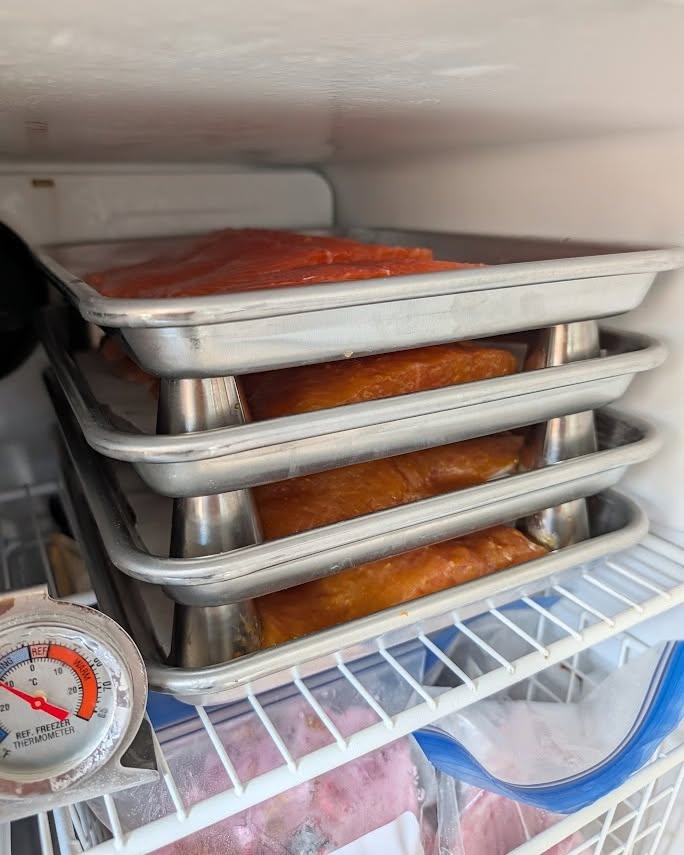
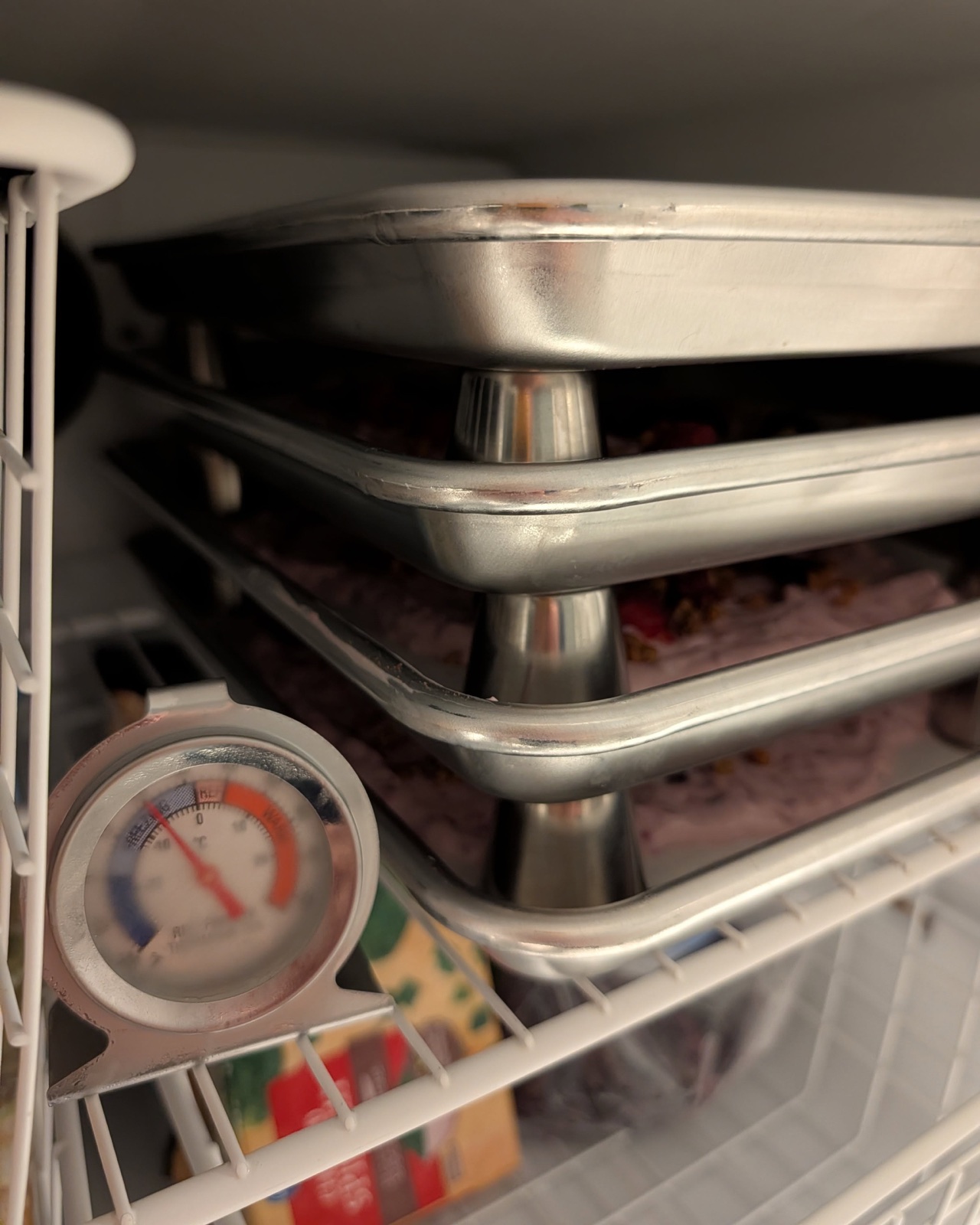
Four quarter sheet pans, each held about an inch above the one below, so every pan has its own open layer and the whole stack takes one 8 inch shelf.
- 4 Nordic Ware Naturals quarter sheets, 12.9 by 9.6 by 1.1 inches, bare aluminum11: Several people asked where the pans came from. The plain Naturals, and they are the same pans the food bakes on.
- 4 domed lids, about 0.85 inches above the rim
- 12 stainless shot cups, 1.5 inches tall, 1.57 inch rim, 1.02 inch base
Two ways to space the pans. Cups, inverted, wide rim down and flat base up, at the four corners. The next pan rests on the flat bases, and each tier is 1.5 inches plus the pan. Or lids: the dome carries the pan above it, about 1.95 inches a tier, and four lidded pans come to roughly 7.8 inches in the 8 inch opening, with no parts to place. Lids win if the dome is flat enough to carry a pan without rocking. Cups are the fallback and cost $8.
Three levels, not four. The freezer shelf is the bottom. A four-pan stack needs three elevated levels. Bottom pan at 0, the second at 2 inches, the third at 4, the fourth at 6, and the top of the fourth pan at 7. That inch of slack is what made the whole thing fit.
Load it in place. Bottom pan into the freezer first, set its spacers, then each pan in turn. Pull them out the same way. Do not build the stack on the counter and carry it in. Lowering a four-high tower of loaded pans onto a wire shelf is worse than placing each pan by hand.
Cool first. Pans go in cool, not hot. Four hot sheet pans warm everything already in the compartment and slow-freeze the contents, which is the opposite of the point. A sheet pan is the fastest cooling shape there is, so this costs 25 to 30 minutes on the counter. The stack also blocks airflow, so expect a few hours regardless.
After the freeze, two paths
Leave it. Lids on, the stack stays where it is. A pan of smashed tacos, a pan of cod cakes, a pan of banana slices, a pan of par-cooked potatoes, each already portioned and already covered. No bagging, no labels, no sink time. But every pan you keep loaded is a pan you do not get back.
File it. Everything comes off the pans and goes into quart bags.
The filing bin
Quart bags, with the air pressed out by dipping them in a pot of water until the pressure pushes the last of it through the opening, then sealed at the waterline. The food is already frozen solid, so nothing gets crushed and no liquid wicks into the seal. Each bag comes out about an inch thick and as rigid as a book.
They stand on edge in the baskets, spines up, newest to the back. You read the labels from above and pull one out like a file. Nothing sits under anything else, so nothing gets buried, and the bag at the back is as reachable as the one at the front.
Why quart, not gallon. A gallon bag is nearly eleven inches in both directions and will not stand in an eight inch shelf. A quart is under eight and holds a meal's worth of anything. Gallons still work laid flat and stacked, which is fine for the reserve and for bulk vegetables you dig into rarely. But that is a pile, not a file.
Bags must freeze flat before filing. One lumpy bag makes its neighbors lean. Freeze flat on a shelf, file the next day.
Label everything. Masking tape and a Sharpie, contents and date. Two flat bags of frozen white protein are indistinguishable.
Consolidation
The move that frees up hardware: after the first freeze, everything from four pans stacks into one pan with parchment between the layers, lid on. That returns three pans for the next round. A full session can run two rounds in the same four pans, with the second round unattended overnight.
What actually needs it
Yes. Loose items that would fuse: berries, meatballs, dumplings, cookie dough balls. Glazed or sticky portions. Wet pastes, like prawn paste or cod cakes. Composed dishes that hold a shape: smashed tacos, crusted cod, papillote packets. Cooked components frozen loose.
No. Anything already separated by parchment. A butterflied chicken breast stacked with parchment does not need it; the parchment does the separating, and the thin geometry freezes fast on its own. Par-cooked potato and sweet potato set with a little contact but break apart when you flex the bag, so spread them in one layer inside the bag and lay it flat. Commercially frozen vegetables arrive IQF already, and a cold tunnel is faster and gentler than a home freezer.
For separated portions with parchment between them, flash freezing is mostly unnecessary. Its value is for things that would weld.
The lid rule
Off while freezing anything with a wet or sticky surface: raw pastes, glazes, marinades, fresh sauce. A sealed lid traps moisture that recondenses as frost on the food. Uncovered, dry freezer air wicks the surface layer off and leaves a firm skin.
On once solid, or from the start for anything with a dry surface. Then the lid switches from obstacle to freezer-burn barrier.
Two stages is normal: uncovered until firm, one to two hours, then lid or bag.
The physics behind it
Freezer burn is surface sublimation. Water leaves the surface and redeposits as frost somewhere else. Only the surface matters, which is why a barrier pressed against the food beats an airtight container with headspace. A fat or sugar glaze is itself a barrier.
Vacuum sealing is not worth it under about three months. At a two to four week turnover, a pressed-flat freezer bag performs the same, and the sealer adds steps instead of removing them: cutting bag stock, cycles with cooldowns, and sticky glazes wicking into the seal bar to make welds that fail silently.
Temperature cycling causes more burn than bag choice. Frost-free units swing 5 to 10 degrees on every defrost. Keep the freezer full. Frozen mass buffers the swing.
Skip blanching. It prevents enzyme degradation past about three months. At a four week turnover it is a wasted step.
Capacity
One pan is about 90 square inches of usable floor. In a single layer: 3 butterflied breasts, 6 to 8 ground pucks, 4 salmon portions, about 1.5 pounds of cubed potato, one 9-square egg batch, or 4 to 6 composed items.
Four pans is 12 to 28 portions depending on the item, so about half a two-week batch. The second round runs unattended, so it costs elapsed time, not effort.
The reserve
Ten portions at the back that do not get touched in a normal week.
Restarting after a bad stretch normally means a prep session, a grocery run and dishes, none of which happen when you are already off track. The reserve makes restarting easier than starting: pull a brick, cook some rice, eat. Label it, rotate it every few months, leave it alone.
Verified in practice
The four-tier stack on the steel cups ran clean on the first salmon batch, 6.5 pounds of it: proper clearance, no rocking, everything solid in a few hours.
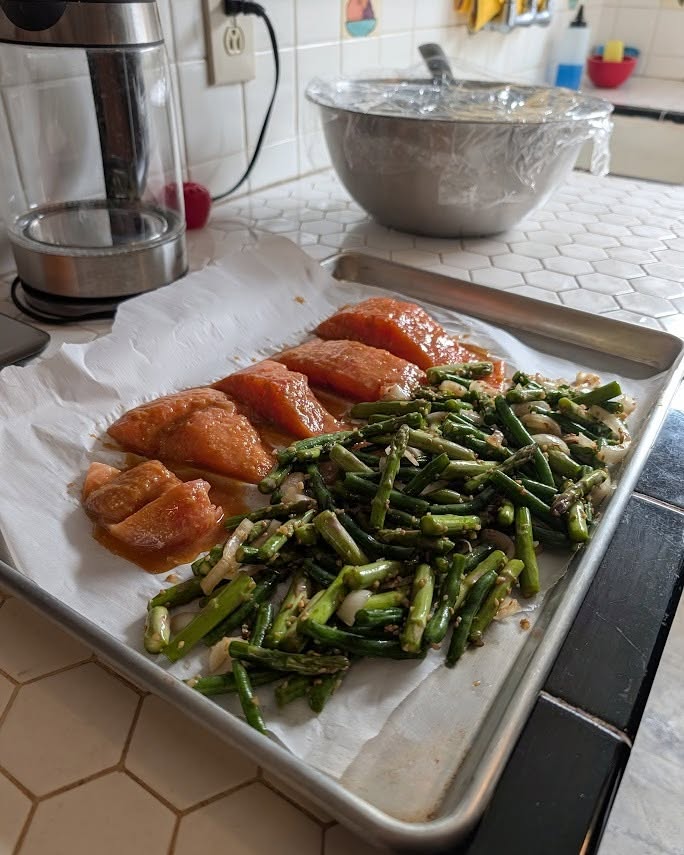
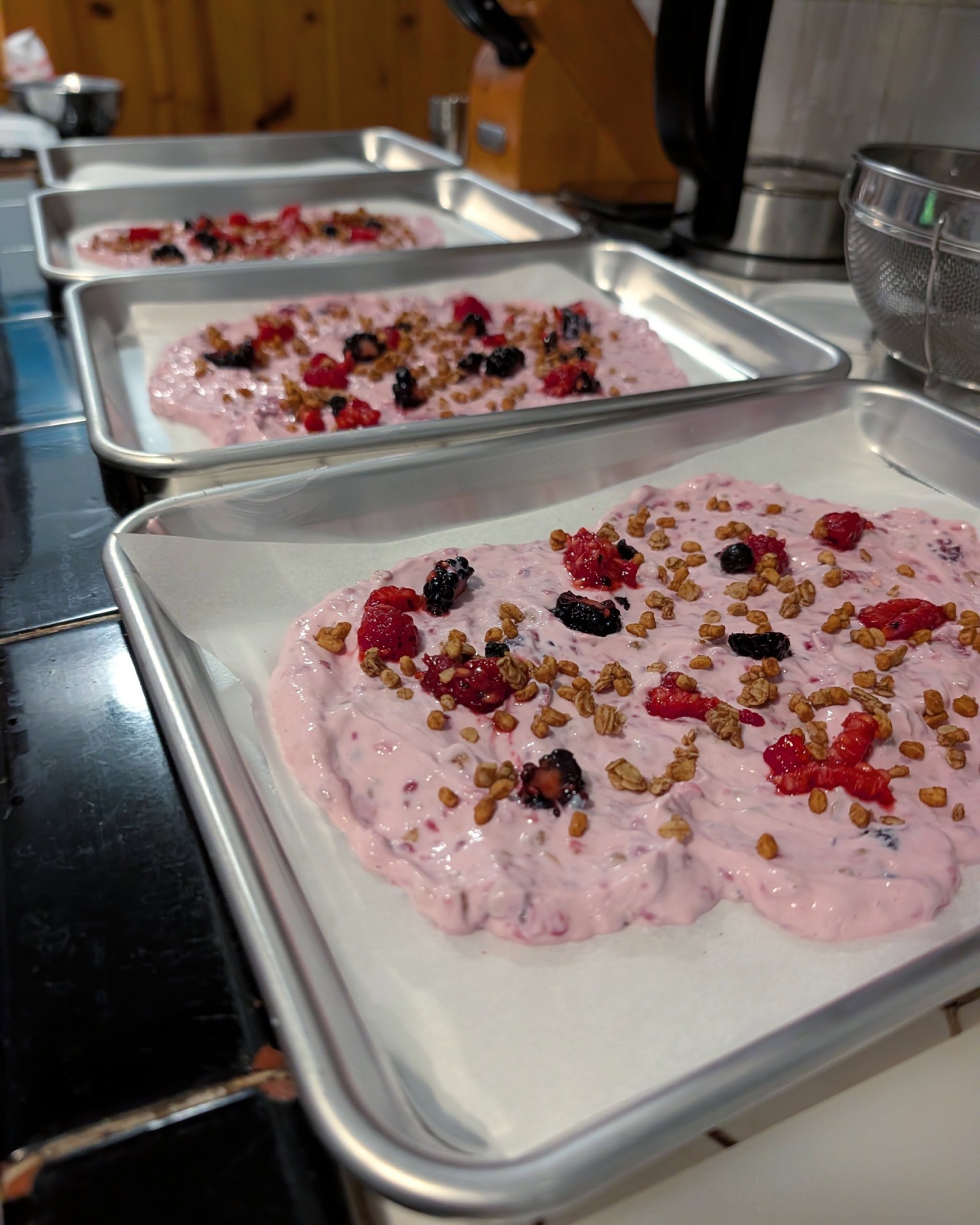
Two notes from that run. Yogurt bark: spread it to the pan edges. Stopping short gives thick-center, thin-edge shards that break unevenly. Glazed salmon: the portions can go into the stack heavily glazed, but wipe most of it off before baking or the sugar scorches before the fish is done.
Failure modes
- Frost inside bags: warm food in, or trapped air.
- Items fused together: skipped the flash freeze.
- Dry, burned edges: long hold, no surface barrier.
- Bags will not stand: frozen lumpy instead of flat.
- Cannot find anything: no labels, or stacked instead of filed.
- Bottom third never eaten: stacked instead of filed.
- Slow freeze, mushy texture: overpacked stack, or hot pans in.
The napkin version
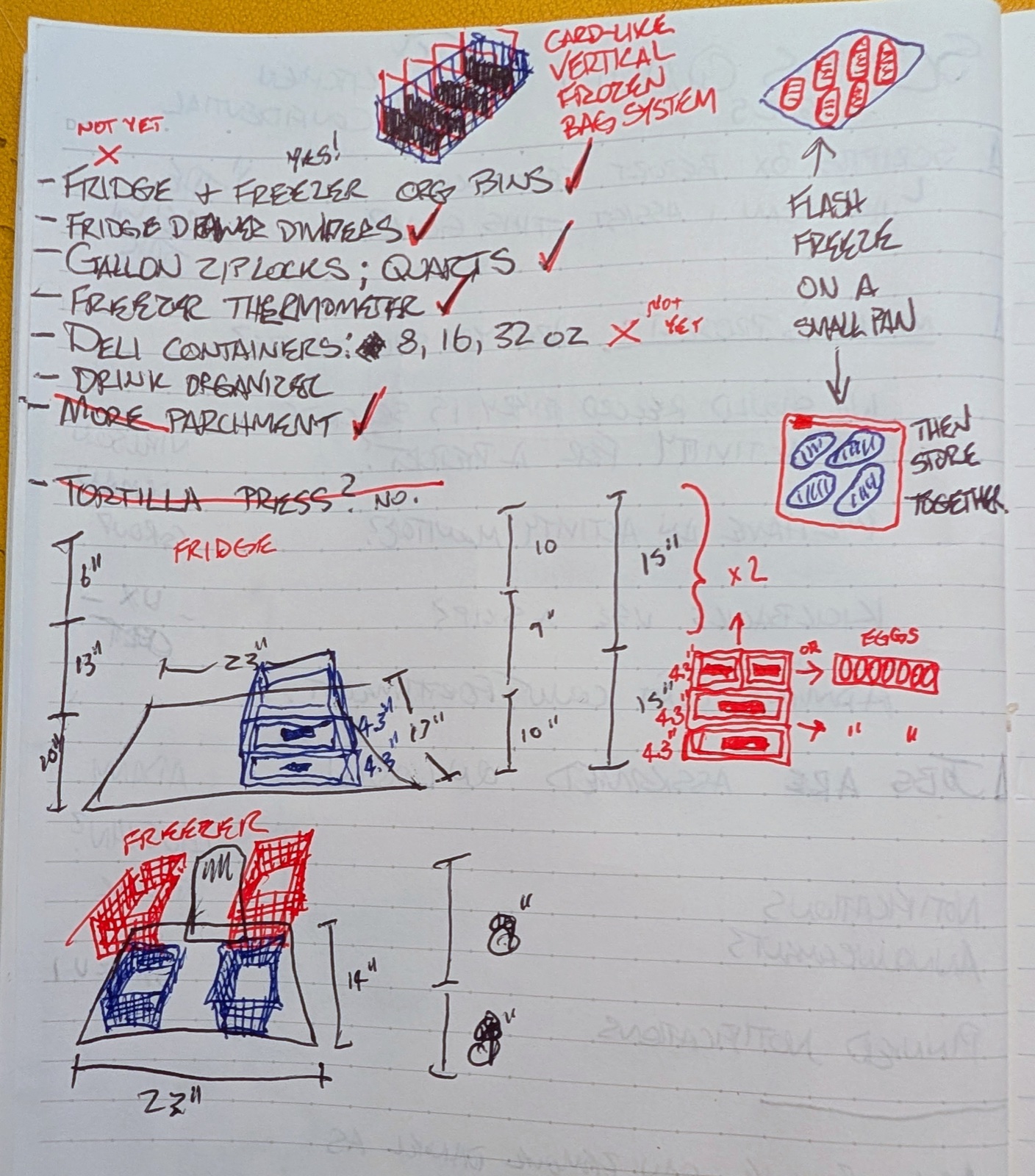
The diagrams on this page are that sketch, drawn properly. Red is hot and cooked. Blue is frozen.